Defence · CANZUK
Four Nations. One Military Giant. Why CANZUK Could Become a Global Military Superpower
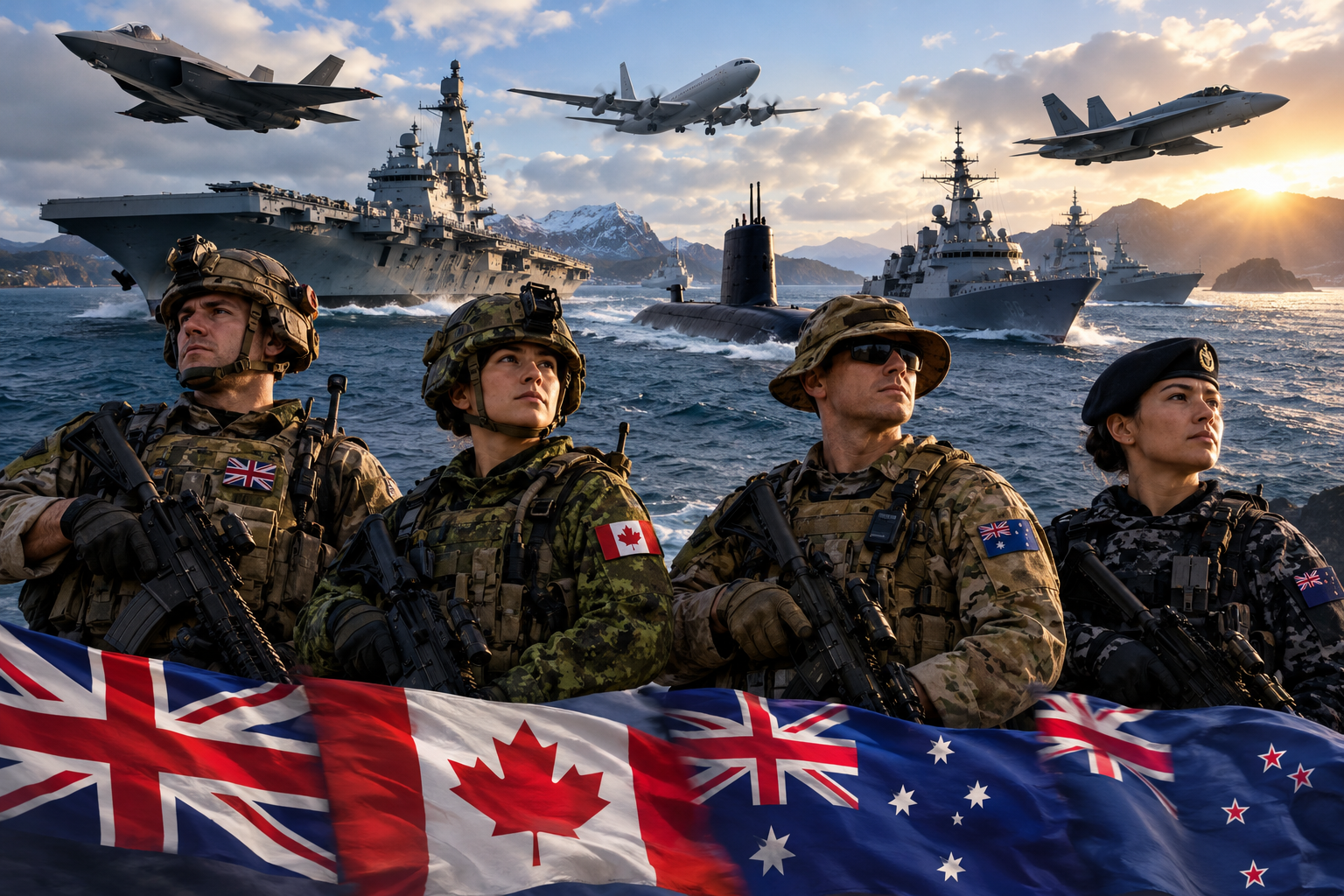
With more than US$160 billion in combined annual defence spending, nearly 300,000 military personnel, nuclear weapons, aircraft carriers and a strategic presence across the world's oceans, a united CANZUK could emerge as one of the most formidable military alliances on Earth.
By The Gazette Editorial Desk · 7 min read
A Sleeping Military Giant
Imagine a military alliance stretching from the frozen Canadian Arctic to the vast Australian Outback, from Britain's Atlantic coastline to the islands of the South Pacific.
An alliance equipped with nuclear submarines, aircraft carriers, fifth-generation fighter jets, advanced intelligence capabilities and some of the world's most highly trained armed forces.
Now imagine that these countries already share centuries of military history, intelligence networks, democratic institutions and a remarkable tradition of fighting alongside one another.
This is not some distant geopolitical fantasy.
These are the foundations of CANZUK.
The proposed partnership between the United Kingdom, Canada, Australia and New Zealand is frequently discussed in terms of trade, immigration and economic cooperation.
Yet its military potential could prove even more consequential.
A united CANZUK could become one of the world's most influential military powers, capable of projecting strength across multiple continents and helping shape the international balance of power.
And the numbers explain why.
The World's Fourth-Largest Defence Spender
According to 2025 figures from the Stockholm International Peace Research Institute (SIPRI), the four CANZUK nations collectively spend more than US$160 billion annually on defence.
Britain leads with approximately US$89 billion, followed by Canada at US$37.5 billion and Australia at US$35.3 billion. New Zealand contributes several billion dollars more.
Combined, that would place CANZUK fourth in the world for military expenditure, behind only the United States, China and Russia.
Consider the significance.
The United States spends approximately US$954 billion annually, China around US$336 billion and Russia approximately US$190 billion.
CANZUK would follow with expenditure exceeding US$160 billion.
That places the four-nation partnership ahead of individual military powers such as India, France and Japan.
And unlike a country attempting to build a military establishment from scratch, CANZUK would already possess sophisticated defence industries, established armed forces and extensive operational experience.
Closer integration could unlock substantial additional advantages.
Joint procurement could reduce duplication. Shared research could accelerate technological development. Coordinated military planning could transform four capable national forces into a far more effective international partnership.
The potential is enormous.
Nearly 300,000 Personnel — And Some of the World's Finest Armed Forces
Across the four nations, approximately 280,000–290,000 regular military personnel serve in their armed forces, with reservists providing additional capacity.
That is considerably fewer than the millions of personnel maintained by China, India and the United States.
But modern military superiority is not simply determined by numbers.
Training, technology, intelligence, professionalism and operational effectiveness can be decisive.
Britain's armed forces possess extensive expeditionary experience, while Australia and Canada operate sophisticated military equipment and maintain close relationships with American and allied forces.
New Zealand contributes specialist capabilities and invaluable experience operating across the Pacific.
Together, these forces could form the backbone of an exceptionally capable military partnership.
A CANZUK defence framework could also expand opportunities for joint recruitment, specialist training and shared military facilities.
The result could be a highly professional, technologically advanced force capable of responding rapidly to crises across the globe.
A Naval Powerhouse With Extraordinary Global Reach
If there is one area where CANZUK could truly distinguish itself, it is at sea.
Few potential alliances possess such remarkable geographical advantages.
Britain commands an important position in the North Atlantic and maintains two Queen Elizabeth-class aircraft carriers, nuclear-powered submarines and advanced surface warships.
Canada provides access to the Atlantic, Pacific and Arctic oceans, alongside substantial naval and maritime surveillance capabilities.
Australia occupies a strategically vital position between the Indian and Pacific oceans, operating modern destroyers, frigates and amphibious assault ships.
New Zealand extends the partnership's reach deep into the South Pacific.
Together, these countries could establish a formidable maritime network connecting Europe, North America and the Indo-Pacific.
Imagine coordinated carrier operations, submarine patrols, maritime surveillance and naval deployments supported by shared logistics and intelligence.
CANZUK could become an exceptionally influential maritime partnership, capable of protecting trade routes, supporting allies and maintaining a presence across several strategically important regions simultaneously.
Its geographical reach alone would make it a serious consideration in global defence planning.
Nuclear Weapons, Fighter Jets and Cutting-Edge Technology
CANZUK would possess another enormous strategic advantage: Britain's nuclear deterrent.
The United Kingdom is one of just nine nuclear-armed states, maintaining a submarine-based deterrent designed to provide a credible response to existential threats.
Although nuclear command would remain under British sovereign control, this capability would give the wider partnership considerable strategic significance.
Beyond nuclear weapons, CANZUK nations operate advanced combat aircraft, including the F-35 Lightning II.
Britain, Australia and Canada also participate in important defence technology programmes, while Australia is working with Britain and the United States through AUKUS to acquire conventionally armed, nuclear-powered submarines.
Add the extraordinary intelligence capabilities of the Five Eyes partnership, and CANZUK's technological advantages become even more apparent.
These are not countries dependent solely on military manpower.
They are advanced economies with access to sophisticated technology, defence research and international intelligence networks.
In modern warfare, those advantages can be worth far more than sheer numbers.
Could CANZUK Rival China and Russia?
China possesses a much larger military, with approximately two million active personnel, enormous industrial resources and rapidly expanding naval capabilities.
Russia maintains one of the world's largest nuclear arsenals and substantial conventional military forces.
Neither would be an easy military competitor.
But CANZUK would possess advantages of its own.
Against China, Australia's position in the Indo-Pacific, Britain's expeditionary capabilities and Canada's Pacific presence would make CANZUK a significant contributor to regional deterrence.
Against Russia, Britain's nuclear capabilities, Canada's Arctic geography and the partnership's North Atlantic presence would be strategically valuable.
CANZUK would not need to match either country soldier for soldier.
Its strength would come from advanced technology, strategic geography, international partnerships and the ability to operate across multiple theatres.
And crucially, CANZUK would not be acting in isolation.
Its members already enjoy close military relationships with the United States, NATO and other democratic partners.
A stronger CANZUK could reinforce those alliances while becoming an increasingly influential strategic grouping in its own right.
Four Nations. One Formidable Future.
Perhaps the most compelling argument for CANZUK is that the foundations of this military partnership already exist.
The four countries share military traditions, intelligence arrangements, operational experience and remarkably close historical ties.
What is missing is a comprehensive framework capable of harnessing their collective potential.
A dedicated CANZUK defence partnership could coordinate military procurement, expand joint exercises, improve interoperability and establish a stronger collective presence across the world's oceans.
It could also give all four nations greater international influence, allowing them to pursue shared security interests with more weight than they could individually.
There would be challenges. Defence integration would require political commitment, investment and respect for national sovereignty.
But the rewards could be extraordinary.
A military partnership ranking fourth globally in combined defence expenditure, equipped with nuclear weapons, aircraft carriers, advanced fighter jets and a strategic presence spanning three oceans would command considerable international influence.
The United States would remain the world's dominant military power. China would retain its enormous numerical advantages.
Yet CANZUK could establish itself as a leading global defence partnership, combining the strengths of four prosperous democracies into something far greater than the sum of its parts.
This would not be about recreating an empire.
It would be about building a modern, confident and globally influential alliance capable of defending shared interests and contributing to international security.
Four nations. Three oceans. One formidable military future.
The potential is already there.
The question is whether the political ambition exists to realise it.